JIN GANG
.jpg)
STATEMENT
In the Buddhist tradition, the written word serves as a temporary vessel for truth, yet the Diamond Sutra cautions that any "form" (Lakshana) is ultimately an illusion. This paradox—the necessity of relying on language while simultaneously needing to break free from it—defines the core of my creative inquiry.
This journey of the mind manifests in a twenty-meter handscroll of traditional ink on Xuan paper. I transcribed the entire Diamond Sutra, yet I allowed the characters to dissolve at the tip of my brush. I intentionally distorted the text until the scripture transformed into a landscape of ink. By stripping the sutra of its readability, I transformed the act of "reading" into an act of "wandering." The rhythmic expansion of the scroll invites the viewer to enter a space where perception and the void gradually merge, encouraging the mind to seek refuge within a visual wandering.
I connected the practice of "breaking the form" to the physical tension between marking and masking in my writing. While traditional scrolls provide a structured path for the mind, I utilized these deformed characters to create a space where the spirit finds no fixed point to rest. In this work, the obscuring of the text serves as a gateway to a deeper reality; it suggests that the "true" sutra resides not in legible words, but in the moment form collapses. I challenge the viewer to confront a fundamental question: do we seek truth by recognizing "forms," or do we see more clearly when the "form" of language finally vanishes?
.jpg)
.jpg)
.jpg)
.jpg)
Jian

STATEMENT
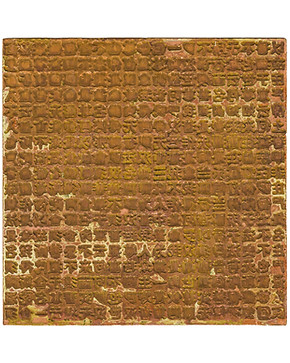
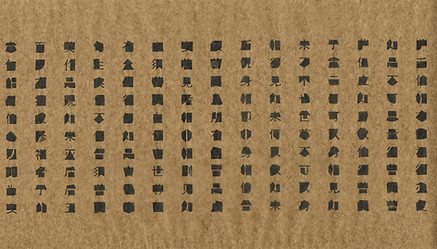
Through a prolonged process of corrosion, the outward forms of the characters on these copper plates have been gradually stripped away, leaving behind only traces of varying depths and silhouettes. These marks appear as shadows remaining after their original meanings have been hollowed out.
No longer functioning as language, these traces form a new visual structure that drifts between the textual and the non-textual. The viewer is compelled to momentarily set aside familiar modes of reading—moving away from a reliance on linguistic comprehension and toward a perception rooted in the act of seeing itself.
Looking forward, this work will expand into a series of fifteen copper plates, presenting a complete yet unreadable rendition of the Diamond Sutra.